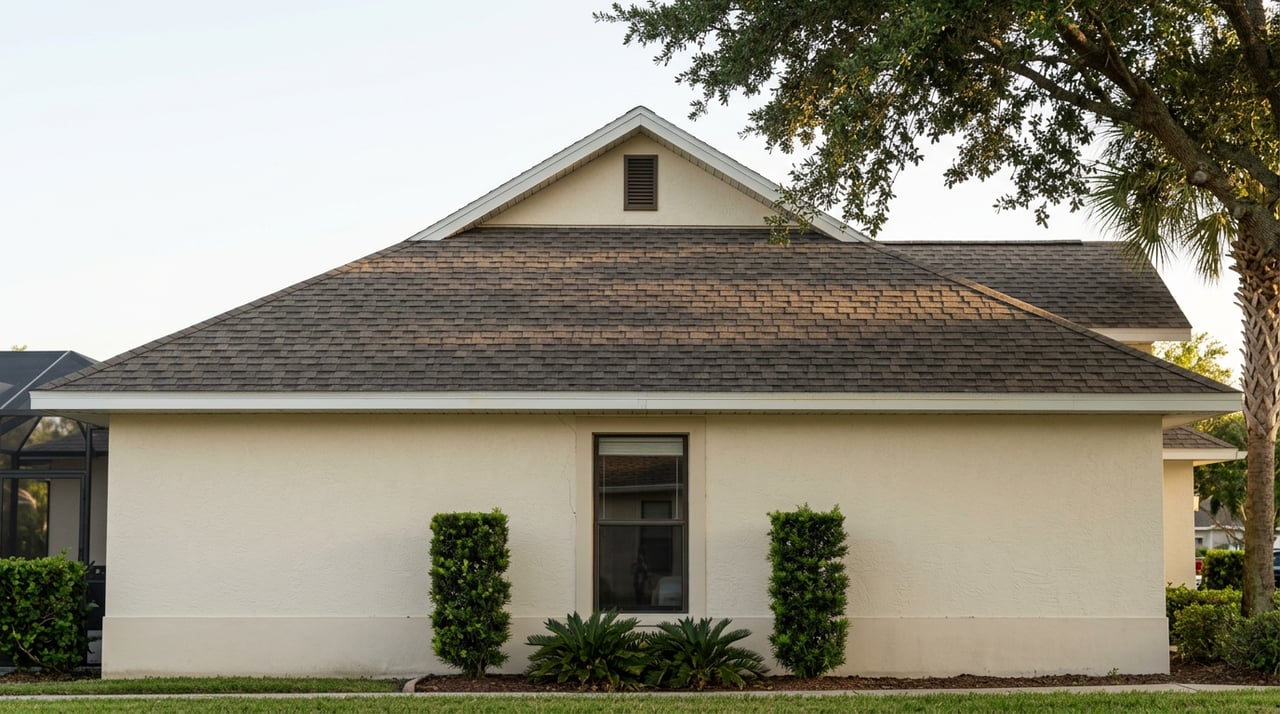
How Bloomingdale Home Prices Shape Valrico Insurance Costs
August 6, 2026
August 6, 2026
Two houses in Valrico's 33596 ZIP, both listed near $400,000. One is a 1987 four-bedroom off Bell Shoals Road with a shingle roof last replaced in 2011. The other is a 2004 build inside Buckhorn Preserve with a tile roof and a filed wind mitigation form. On the portal, they look like comparable options. In the underwriting queue, they are not the same asset, and the gap between them is where most buyers in this pocket lose money.
That gap is the thesis of this post. Bloomingdale's headline median is not a neighborhood discount. It is an insurance-underwriting discount on aging shingle roofs, and the true price of the home is the sticker plus the bound premium plus the roof-replacement runway.
The trailing-12-month Bloomingdale median sits at about $403,000, up 3.9% from the prior 12 months and up 183% since 2012, when it was $142,000. Broader Valrico looks pricier: a July 2026 median list price around $470,000 per Movoto, and Momentum Realty's June 2026 relocation guide pegs the typical Valrico home closer to $500,000 with a 52-day median time on market.
The instinct is to read that spread as a bargain in Bloomingdale. It isn't. Bloomingdale's build-out began around 1979 east of Bell Shoals Road and grew through the 1980s and 1990s, and the housing stock is largely 1980s and 1990s single-family, so condition, roof age, and insurability drive value far more than the Bloomingdale name. The lower median is the market pricing that risk. The buyer who ignores it pays the sticker and inherits the risk anyway.
Compare three sub-communities inside the same Valrico footprint, all pulled from live Stellar MLS reads dated within the last month:
| Community | Vintage | Median (2026) | DOM | Months of Supply |
|---|---|---|---|---|
| Bloomingdale (est.) | 1980s–1990s | ~$403K | 24 | 2.5 |
| Buckhorn Preserve | 2002–2005 | ~$394K sale / $420K list | 19 | 4.3 |
| Vivir by Onyx+East | 2024+ new build | ~$413K | 73 | 2.0 |
The prices cluster. The vintages don't. Buckhorn Preserve's median sale is about $394K at $202 per square foot with 19 days on market and 4.3 months of supply, a balanced market, and Vivir's median is about $413K at $216 per square foot with 73 days on market and 2.0 months of supply. A buyer looking only at price per square foot would call these interchangeable. An underwriter would not.
Here is the mechanism the portal never surfaces. Florida's insurance market in 2026 treats a shingle roof as a depreciating asset with a hard schedule attached.
Florida Statute 627.7011 prohibits insurance companies from refusing to issue or renew a homeowners policy solely because of roof age if the roof is less than 15 years old. Between 15 and 25 years, a certified inspection confirming 5+ years of remaining life is required to maintain coverage. Beyond 25 years, most private carriers may refuse coverage, leaving Citizens Property Insurance as the primary option.
That is the statute. The carrier behavior around it is stricter. Most Florida insurance companies won't write new policies on roofs older than 10 to 15 years without inspection, and for renewals, companies typically non-renew at 15 to 20 years regardless of actual condition. The payout math shifts too. Many Florida policies now include a Roof Payment Schedule, a hybrid where the roof is covered at replacement cost for its first few years, but automatically switches to actual cash value as it reaches a certain age. This prevents "free roofs" for homeowners who simply have old, worn-out surfaces.
Translate that to the 1987 Bloomingdale example. If the roof was reshingled in 2011, it is fifteen years old at the 2026 closing. The buyer inherits a policy that either requires an immediate inspection with a five-year useful-life certification, converts to actual cash value on the roof, or lands the household on Citizens. The roof age surcharge can account for 20 to 30% of the total policy cost.
None of that is written on the listing.
Two things landed this summer that reshape the math, and both cut against the story most buyers heard.
First, the legislative story. HB 815 and SB 808, which would have prohibited insurers from refusing or renewing property policies solely because of roof age, died in the Insurance and Banking Subcommittee on March 13, 2026, and existing Florida Statute 627.7011 protections remain unchanged. The 15-year cliff was not sanded down. It is still there.
Second, the Citizens story. Effective July 1, 2026, Citizens Property Insurance implemented a rate reduction averaging approximately 8.8% on multiperil policies and 5.5% on wind-only policies, the first meaningful rollback in several years after continuous increases through 2022, 2023, and 2024. That helps, but Citizens is still the fallback, not the plan. Citizens is the insurer of last resort, not the cheap option, and policyholders carry assessment risk after major storms.
The broader market softened slightly. The average cost of Florida homeowners insurance in 2026 is roughly $3,240 to $4,500 per year, making Florida one of the most expensive states in the country, roughly two to three times the national average. In a Bloomingdale carrying-cost model on a $400,000 home, the premium is a second mortgage payment. Roof status decides which end of that range the buyer sits on.
Local friction shows up here. These are the numbers a Bloomingdale offer should include, and the reasons portal-shopping buyers miss them:
The permitted roof install date, pulled from Hillsborough County records. Not the seller's verbal answer, not the disclosure form. Trusting a verbal age claim from the seller is a common failure pattern; carriers require documentation, and a county permit search confirms actual age. The age of the roof is determined by the date of the last full replacement, not by patch repairs or partial re-roofs, and only a complete, permitted reroof establishes a new installation date for insurance underwriting purposes.
A current wind mitigation report on form OIR-B1-1802. Florida homeowners who upgrade to code-compliant roofing systems can save up to 45% on insurance premiums, but the savings require formal submission of wind mitigation inspection documentation to the carrier and do not apply automatically. On a Bloomingdale house built to earlier code, the report is often the difference between an insurable policy and a Citizens fallback.
The bound premium quote, before the debt-to-income calc. Lenders qualify the loan against the actual premium, not the sticker. The qualifying number is the debt-to-income ratio with the bound premium included, not the asking price.
The corollary is uglier. Waiving the roof inspection to win a competitive offer is a pattern we see often; speed today can mean a non-renewal in 18 months.
The Bloomingdale purchase most likely to unravel is the one where a buyer, encouraged by the sub-$405K median, waives inspection contingencies and discovers the insurance quote after the appraisal. At that point three doors are open, none of them free:
None of that is a disaster if it is planned. All of it is a disaster if it is discovered at week five of a thirty-day close.
The subdivision layer inside Bloomingdale matters too. Roughly half of Bloomingdale's sections carry a mandatory HOA and roughly half are voluntary, so covenants and carrying costs vary per subdivision, and the Bloomingdale Golfers Club is a separate semi-private club, not a community-owned country club, so club membership is optional. Two houses on adjacent streets can carry different HOAs, different insurance realities, and different resale stories. That is the neighborhood, read honestly.
Is Bloomingdale actually a seller's market right now? As of July 15, 2026, Bloomingdale leans toward sellers, with 2.5 months of supply and 25% of the inventory already under contract; confidence is very high with 12 active and pending listings and 83 closed sales in the trailing 12 months. Prepared buyers still have room on anything overpriced against the roof and insurance picture.
What percentage of Bloomingdale sales are cash? Cash buyers took 13% of Bloomingdale sales in the 12 months ending June 2026, or 11 of 87 closings. Cash buyers face the same insurance market at renewal, they just delay the reckoning.
Do newer communities like Vivir solve the problem? Largely, yes, at the cost of new-construction pricing and a longer time on market. Vivir by Onyx+East is a new-construction community of roughly 82 homesites in the Bloomingdale area of Valrico, in the 33596 ZIP, offering detached two-story homes from about 1,660 to 2,462 square feet, with amenities including a dog park, playground, hammock area, open green space, and a fire pit; the community launched in March 2024.
Bloomingdale still delivers what it always did: mature oaks, the Campo Family YMCA, the Bloomingdale Regional Library, quick access to the Selmon Expressway. What it does not deliver in 2026 is a free discount. The median is doing work that most listing photos hide.
If you are weighing an offer in Bloomingdale, Buckhorn Preserve, or Vivir this summer, Carter Company Realtors will read the roof, the mitigation form, and the bound premium against the comp before you sign anything. Get Your Free Home Valuation and we will start with the numbers that actually decide the deal.
Whether you are looking to buy or sell a home, Carter Company Realtors has all the knowledge and tools to get the job done right, Work with us today!